Nile River Map
Learn about the Nile River, its life, history, sources, and facts.
For more than 5,000 years, Egypt has relied on the Nile River for its fertile soil, which is used to grow commodities like cotton and wheat. It has long been the primary transit route, supporting trade and building endeavors over its 6,650 kilometers. Egypt’s calendar was affected by the Nile, which separated it into growing, harvesting, and flooding seasons. With gods like Hapi and Osiris symbolizing fertility and regeneration, it had deep religious and cultural significance. Egypt’s economics, politics, and spiritual life revolved around the Nile, which represented the harmony between chaos and order.
Synopsis
- For more than five millennia, Egypt’s people, crops, and economy have all depended on the Nile River, which flows through Africa.
- It is vital to Egyptian agriculture, spanning 6,650 kilometers and supplying fertile soil for crops like cotton and wheat through yearly flooding.
- In addition, the river served as Egypt’s main thoroughfare for trade and large-scale building projects.
- Flooding, growth, and harvest are the three agricultural seasons that make up the Egyptian calendar.
- With gods like Hapi and Osiris representing fertility and renewal, the Nile has enormous religious and cultural significance. The Nile, which connected Upper and Lower Egypt and was essential to Egypt’s political, economic, and spiritual life, had a significant impact on how the ancient Egyptians perceived chaos vs order.
Every Egyptian soul receives life from the Nile River, a living marvel. This article’s goal is to provide every tourist with all the information, statistics, and specifics regarding the significance and background of the Nile River. A highly qualified group of tour operators, tour guides, and researchers with extensive experience of the famous Nile River wrote this page. The Nile River has been the main irrigation source since the beginning of civilization, thousands of years ago, turning the surrounding dry region into lush agricultural land.
In addition to being a vital conduit for trade and transportation, the river is being used for irrigation today. The remnants of ancient civilizations surround the Nile River in Egypt, which symbolizes a link that unites all families along its banks.
“Egypt is the Gift of the Nile” is an old saying that passed spontaneously through the minds of most people all over the world without paying attention or realizing its real meaning or importance. There is no natural landmark in the world that can capture your imagination just like the Nile River. The Nile River is more than just a river, but a gateway to the heavens and a means of communication between a wide variety of nations from Lake Victoria to the Arabian Desert and the Nile Delta.
The Nile River Map and Where it is Located?

is one of the most significant waterways in history, stretching across the African continent from south to north, beginning in the rivers that flow into Lake Victoria and ending in the Mediterranean Sea. Spanning over 6,600 kilometers (4,100 miles), the Nile River is the longest in the world. The Nile River is the ultimate waterway as it links the countries of the Nile Basin that cover 11 African countries, which are:-
This shared resource is a crucial lifeline, as it provides water, sustenance, and economic resources to all these nations. The Nile is fed by two main tributaries, each with unique characteristics and geographic significance:
1. The White Nile
Often considered the Nile’s primary tributary, the White Nile begins in the Great Lakes region of Central Africa, flowing northward through countries such as Burundi, Rwanda, Tanzania, and Uganda before merging with the Blue Nile in Sudan.
2. The Blue Nile
The primary source of ninety percent of the water. This tributary is responsible for nearly 90% of the Nile’s water volume and silt, which originates from Lake Tana in the Ethiopian highlands. The nutrient-rich silt of the Blue Nile is particularly crucial for agriculture, as it replenishes the soil along the river’s banks each year
The convergence of these two tributaries occurs at Khartoum, the capital of Sudan, where they join to form a single river flowing northward into Egypt. Lake Victoria, the largest lake inAfrica, is traditionally considered the source of the Nile, despite multiple feeder rivers adding to its volume. Within Egypt, the Nile extends from the northern borders of Lake Nasser in Aswan, winding through major cities such as Luxor and Cairo, until it reaches its endpoint at the Mediterranean Sea. Just north of Cairo, the river splits into two branches, known as the Damietta and Rosetta branches, forming the Nile Delta, which fans out across the Mediterranean coastline
Nile delta
The Nile Delta is among the largest river deltas on Earth, renowned for its rich agricultural lands and extensive population. Stretching from Alexandria in the west to Port Said in the east, the delta spans about 241 kilometers (150 miles) along the Mediterranean coastline and reaches roughly 161 kilometers (100 miles) from north to south.
This vast deltaic region is densely populated and home to over 40 million people, making it one of the most heavily settled areas in Egypt. The fertile delta has supported human settlement and agricultural development for thousands of years, providing an ideal environment for cultivating essential crops such as wheat, barley, and cotton.
Within the delta, the Nile River splits into two main distributaries as it approaches the Mediterranean:
The Damietta Branch: Located on the eastern side, the Damietta branch extends through the eastern delta region, providing water to various towns and cities along its path.
The Rosetta Branch: The Rosetta branch flows westward, coursing through several historic regions before reaching the
Mediterranean Sea
Together, these two branches form the Nile Delta, a triangular expanse that has historically served as the “breadbasket” of Egypt, responsible for producing a substantial portion of the country’s agricultural output. The annual flooding of the Nile, which brought nutrient-rich silt from upstream, was essential for maintaining the delta’s fertility. However, with the construction of the Aswan High Dam in 1970, the natural flood cycles ceased, impacting the nutrient supply and prompting the need for modern irrigation and fertilization practices.
The Nile Delta’s strategic and economic importance has also made it a hub of transportation and trade, with major ports like Alexandria and Port Said facilitating commerce between Egypt and the Mediterranean world. Due to the delta’s low-lying topography, it faces challenges from sea-level rise and climate change, which threatens its arable land and dense population. Efforts to protect this critical region are ongoing, aiming to preserve its agricultural productivity, unique ecosystem, and cultural heritage.
Historical Role of the Nile River
The Nile’s name is derived from the Greek word “Nelio,” which means river valley. But the ancient Egyptians called it AR or Aura, which means “black,” a reference to the rich, dark sediment that the Nile’s waters carried all the way from the Horn of Africa northward and deposited in Egypt as the river flooded its banks each year in late summer.
The surge of water and nutrients turned the Nile Valley into productive farmland and was the main reason behind the rise of Egyptian civilization to develop in the heart of a desert. The ancient Egyptians divided their country into two parts; the first part, Kemet, the “black land” of the Nile Valley, contained life in the form of water and food for cities to thrive and build, and the second was the hot, dry desert areas, which were known as Deshret, the “red land.”
In ancient times, the ancient Egyptians settled along the banks of the Nile River, where they built simple houses and cottages for accommodation, grew many crops, and domesticated some animals. Since then, the first steps toward immortal Egyptian glory began. Cultivation was the starting point as the Nile River overflowed, carrying silt deposits that covered the neighboring lands along the Nile Valley and made them fertile.
Wheat was the first crop the ancient Egyptians cultivated, dependent on the Nile floods as a solution to the threat of starvation and lack of food at that time. On the other hand, they used some animals such as water buffalo and camels for food, plowing, and carrying goods
In brief, the Nile River is essential for people, crops, and livestock. Gradually, most of the Egyptians moved to the Nile Valley, where they could get their sustenance. As the Ancestors joined together on the Nile banks, they produced the heavenly ancient Egyptian civilization, one of the greatest civilizations in all of mankind’s history, which witnessed the building of many temples and tombs with precious treasures and jewelry. The influence of the Nile River extends to Sudan, where it significantly contributed to the rise of the Sudanese kingdoms.
Divine Religious Facts of the Nile River
As part of the ancient pharaohs’ interests in religious life and their insistence on creating many ancient Egyptian gods and goddesses from physical elements, they honored the Nile River by creating Sobek, “Deity of the Nile,” or as it was also called, “Deity of the Crocodile.” This deity, depicted as a man with a crocodile’s head, represented fertility, wetlands, medicine, and sudden death. The Nile River is regarded as the lifeblood of Sobek. Another deity related to the Nile in ancient Egyptian mythology is “Happy,” also known as “Lord of the River Bringing Vegetation” or “Lord of the Fish and Birds of the Marshes.” This deity controlled the Nile’s yearly floods, which greatly regulated the water level, symbolizing fertility.
The water deity “Khnum,” who ruled over all forms of water, such as lakes and rivers in the underworld, was believed to control the amount of silt that flooded the riverbanks each year. The overflows carried rich silt to the lands of the Nile Valley to cultivate crops
The Nile River served as the source of innovation and the center of life for the ancient and modern Egyptians. The Nile became known as the mother of all men and the father of life, recognized as the key to existence. In the ancient Egyptian language, the Nile was known by the ancient Egyptians as H’pt or Iter,u, which means “River.” Ar or Aur means “Black,” which also refers to the black silt left behind after the yearly flooding.
The word “Nile” was derived from two words: “Neilos,” a Greek word meaning Valley, and the Latin word “Nilus.” Today, the Nile in Egypt and Sudan is known as Al-NTL, Al-Bahr, Nahr Al-Nīl, or Bahr Al-NTL. The Nile River Cruise is one of the most spiritual journeys on the planet and is considered the most ideal way to explore all the allure, history, and aspects of the heavenly Nile River.
The annual flooding of the Nile, known as the “Inundation,” was eagerly anticipated by ancient Egyptians, as it brought life-sustaining water and fertile silt to the valley. Each year, the people depended on this predictable flooding cycle to nourish the farmlands along the Nile’s banks, making the river an essential agricultural force. The importance of the Nile floods was such that the ancient Egyptian calendar was structured around them, dividing the year into three main agricultural seasons.
Akhet, the season of inundation, took place from roughly June to September, during which the Nile overflowed its banks, depositing nutrient-rich silt on the surrounding fields. Following Akhet was Peret, the season of emergence and planting, spanning October to February, when the water receded and farmers began planting in the moist, fertile soil. The final season, Shemu, represented the season of harvest and drought from March to May, a time for gathering crops before the next flood
Egypt’s reliance on the Nile’s seasonal flooding has transformed with advancements in water management and technology. In 1970, the construction of the Aswan High Dam fundamentally altered Egypt’s approach to flood control. By regulating the Nile’s flow, the dam allowed for more consistent irrigation, reducing the unpredictable nature of traditional flooding and boosting agricultural productivity. The dam also generated hydroelectric power, contributing to Egypt’s energy resources.
However, while the dam has brought stability and facilitated year-round agriculture, it has also stopped the natural deposition of silt, requiring more intensive fertilization of farmland. Despite these changes, the legacy of the Nile’s flooding remains a powerful symbol of life and prosperity in Egyptian culture, echoing the ancient understanding of the river as the source of all life
Discover the Sources & Origin of the Blessed Nile River
The White Nile and the Blue Nile, each of which brings unique waters from different parts of Africa, are the two main tributaries of the Nile River, which is known as the longest river in the world. The beautiful area around Lake Victoria in East Africa is where the longest river, the White Nile, starts. It supplies a steady stream of water that powers the river’s northward flow through Sudan, South Sudan, and Uganda. In contrast, Lake Tana in the Ethiopian Highlands is the source of the Blue Nile, whose waters are rich in nutrients due to high seasonal rainfall. The Blue Nile plays a crucial role in the productivity of the river since agriculture depends on these seasonal floods.
At Khartoum, Sudan, these two tributaries unite to form a single river that travels north through Egypt before emptying into the Mediterranean Sea. These waters from the equatorial rainforest and mountains come together to form a river that has enormous natural power and agricultural value.
The Nile’s course represented life and prosperity, and its beginnings were revered in ancient Egyptian belief. The Nile’s life-giving waters are attributed to the gods themselves in numerous stories and myths that describe the river’s origin as the result of divine energies. The Nile was frequently viewed as a link between the divine and mortal worlds, delivering life straight from the gods, and its origins and flow were so highly revered that they became intricately linked to Egyptian identity and spirituality.
Mixed and Colorful Wildlife of the Nile River
A critical lifeline across otherwise dry regions, the Nile River, which stretches from the heart of Africa to the Mediterranean Sea, has long sustained an extraordinarily rich diversity of animal life along its fertile banks and vast waters. Numerous fish species may be found in this biologically rich river system, and for thousands of years, these fish have been vital sources of food and livelihood for the surrounding populations. Among these, the African tigerfish—a vicious predator dubbed the “Piranha of Africa” due to its sharp teeth and aggressive hunting style—as well as the Nile perch, tilapia, and catfish are especially noteworthy.
The reputation of the river as a plentiful fishing resource is mostly due to the Nile perch, a huge predatory fish that distinguishes out for reaching substantial sizes. One more intriguing resident
The reputation of the river as a plentiful fishing resource is mostly due to the Nile perch, a huge predatory fish that distinguishes out for reaching substantial sizes. The Gundu catfish, a huge species that may weigh over 50 kilograms (110 pounds) and is highly valued by local fishermen, is another intriguing resident.
Along the Nile, birdlife thrives, particularly in the Nile Delta, where freshwater and the saltier Mediterranean combine to provide the perfect habitat. In addition to approximately 300 different bird species, including migratory and resident birds like the African fish eagle, herons, and kingfishers, this area is home to sizable numbers of water birds like egrets, ibises, and small gulls. In order to preserve the biological balance of the river, thousands of birds congregate periodically along the marshes and lagoons, producing colorful spectacles.
The Nile River was the best way to record Egyptian civilization in history; it’s also the secret to success in other fields. The Nile River provided the ancient Egyptians with an important transportation route, which, as a result, encouraged them to become skilled boat and shipbuilders. Artwork from the Old Kingdom, which existed from 2686 to 2181 B.C., depicts boats transporting cattle, vegetables, fish, bread, and wood.
Boats were so important to the ancient Egyptians that they buried deceased kings and dignitaries with boats, like the solar boat of King Khufu. An ancient papyrus diary of an official who lived during the Old Kingdom showcases the construction of the Great Pyramid and describes how workers transported massive blocks of limestone on wooden boats along the Nile through a canal system to the construction site
Cultivation was the first activity that formed the foundation and pillars of the Egyptian empire. When the Nile River flooded, the water level rose, carrying the rich silt deposits and overflowing the lands of the valley, which made them more fertile. The ancient Egyptians took advantage of the flood season to grow crops for their sustenance. They depended on some domestic animals in their lives to help them with agricultural work
Unique & Amazing Geography of the Nile River
The Nile River stretches an astounding 4,132 miles (6,650 kilometers), making it the longest river on Earth and a geographic marvel. Flowing northward, an unusual direction for a river, the Nile crosses through eleven African nations, culminating in the Mediterranean Sea. In Egypt, the river serves as a vital corridor from the southern border with Sudan to its expansive, fan-shaped delta region just north of Cairo.
This delta, where the Nile disperses into several smaller distributaries before emptying into the Mediterranean, covers approximately 240 kilometers (150 miles) of coastline and reaches about 160 kilometers (100 miles) inland, making it one of the world’s most agriculturally productive regions
The Nile’s journey through Egypt includes several notable cities. It begins in the south near Aswan, where the river is harnessed by the Aswan High Dam, which regulates water flow, controls flooding, and provides hydroelectric power. As the river winds northward, it flows past the ancient city of Luxor, once the heart of Egyptian civilization, and continues through Cairo, Egypt’s bustling capital.
The Nile Delta, rich with nutrients and divided by the Rosetta and Damietta branches, is a lush region ideal for agriculture, where crops such as wheat, cotton, and vegetables thrive. This corridor of life, bordered by arid desert, is a testament to the Nile’s power, as it creates a ribbon of green and sustenance across an otherwise barren landscape. Historically, this fertile land was key to Egypt’s growth and prosperity, sustaining communities for millennia and forming the backbone of Egyptian society, culture, and economy
Recommended to Experience the Nile River Cruise
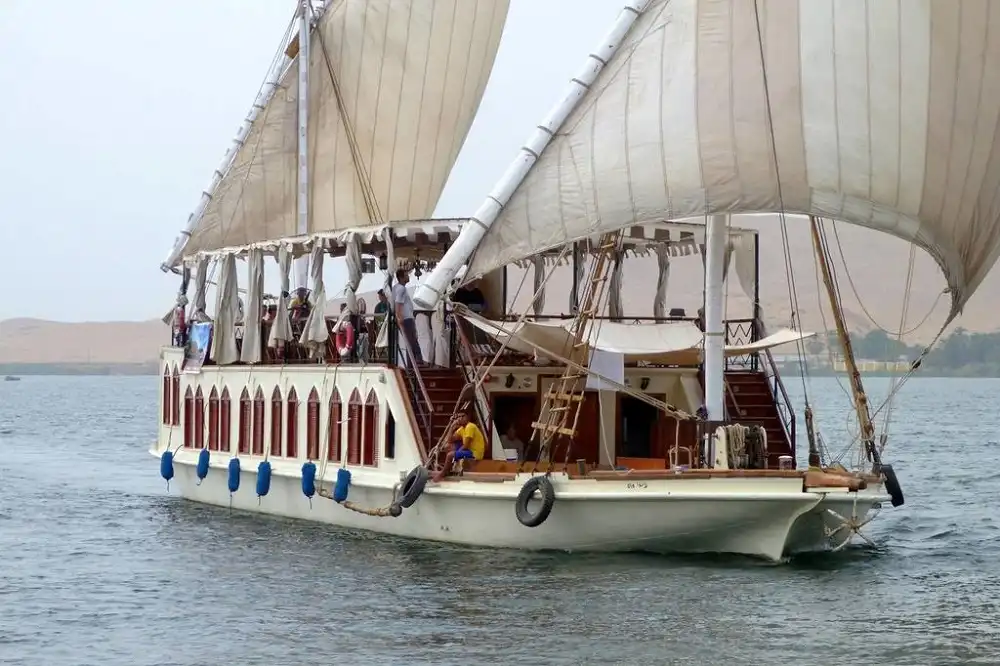
As mentioned before, the ancient Egyptians settled down and established their civilization on the banks of the Nile River. Thus, most of Egypt’s historical destinations are located on the Nile shores, especially in Upper Egypt. Accordingly, travel agencies and trip planners in Egypt tend to take advantage of the Nile’s phenomenal geographic accessibility and its remarkable historical attractions along its banks, making it a part of their Egypt tour packages in and around Luxor and Aswan.
This magnificent waterway is the best way to witness many more of the timeless pharaonic temples and tombs, including the Karnak Temples, the Temple of Queen Hatshepsut, the Valley of the Kings, the Abu Simbel Temple, and the three majestic temples of Philae, Edfu, and Kom Ombo, which directly overlook the Nile stream. Onboard the Nile cruise, travelers can enjoy numerous activities, fresh food and drinks, listen to music and dance, relax in deluxe swimming pools, and also have massage sessions available with the best service ever
They add an option to see Luxor and Aswan’s spectacular landmarks on board a marvelous Nile river cruise, where everyone will get to discover both ancient and modern Egypt, so you can check our Nile cruises below and book the best one suitable for you