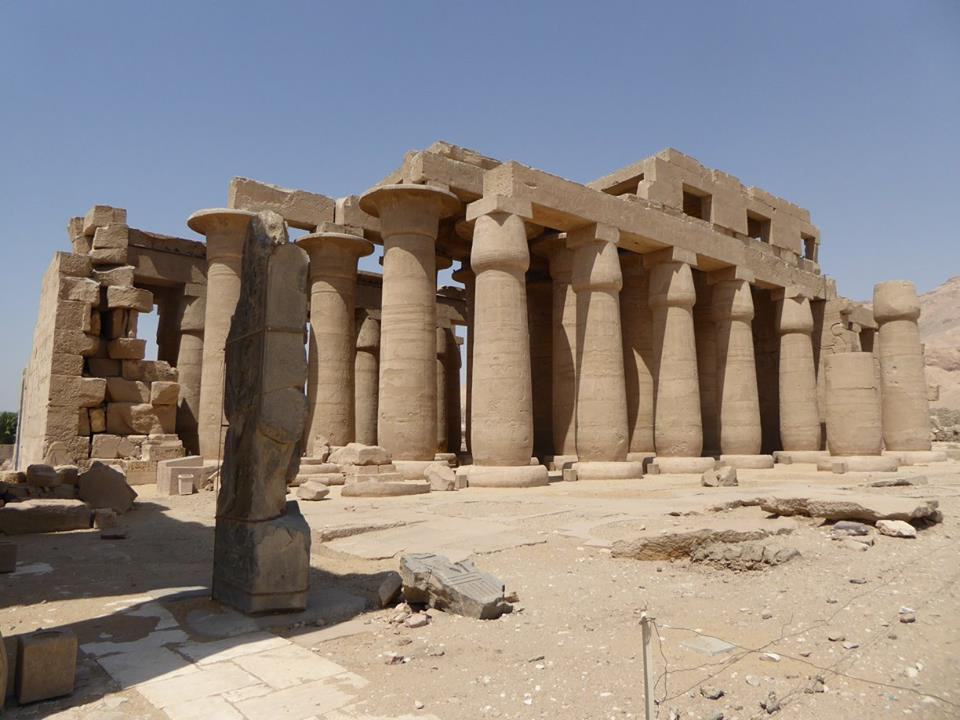
Today, relatively little remains of what is thought to have once been the most impressive temple complex on the West Bank of the
Nile. Several clusters of pillars and a few damaged statues stand among a large field of ridges, holes, broken foundations, and pieces of statuary that mark out where the rest of the complex once stood.
The reputation of this site is now tied more to the reputation of the man who commissioned it than to the appearance of its ruins. Ramesses II is the name most often heard in association with many of the monuments around Luxor and further south.
He was a prolific builder and also had a habit of repurposing existing monuments to add to his reputation He was the greatest conqueror in the history of Ancient Egypt, ruling for 67 years during the New Kingdom (1279–1213 BC) and extending the range of his kingdom into new frontiers in the southwest.
and north in Syria. This temple is dedicated to him and a testament to his power and influence, and it is meant to be the greatest of all monuments. Plundering by subsequent pharaohs, who could no longer afford to quarry their own stones, natural disasters, and finally these sites’ use as a church by early Egyptian Christians have all taken a toll on this once great structure.
But even
among the scattered ruins, evidence of its greatness still persists. There are the remains of a toppled colossus of Ramesses II that is estimated to have stood over six stories tall, the largest freestanding sculpture ever in
Egypt and one of the largest ever attempted anywhere in the world.
The decoration of the remaining columns in the hypostyle is also impressive, showing the fine craftsmanship that defined the Ramesseum’s construction. Though relatively little remains, the Ramesseum is still an exciting visit, especially for those with a particular interest in the life of Ramesses II.
the greatest of the pharaohs. Its layout was the inspiration for the much better-preserved temple complex at Medinat Habu, constructed by Ramesses III.
