About Egyptian gods
The ancient Egyptians believed in many different gods and goddesses. Each one had their own role to play in maintaining peace and harmony across the land. Find out about their special powers and duties.
Some gods took part in creation and others brought a flood every year, which was important for growing crops. Some offered protection while others took care of people after they died. There were local gods who represented towns and minor gods who represented plants or animals. A few gods were very dangerous! The ancient Egyptians believed that it was important to recognise and worship these gods and goddesses so that life would continue smoothly.
Learn about the first nine gods and goddesses (the Ennead). Then browse our list of 35 ancient Egyptian gods and goddesses below, or use the letters above to find a specific god.
The Ennead
Ancient Egyptians had several myths regarding the creation of the world. One of the most popular creation myths featured the Ennead, a group of nine ancient Egyptian gods and goddesses. Atum was thought to be the first god and creator of the world and from Atum the Ennead were born. They were like a big family of magical beings and each member had their own unique powers and responsibilities. Together the Ennead made Egypt a special and vibrant place to live.
Atum’s children were Shu and Tefnut.
Shu and Tefnut gave birth to Geb and Nut;
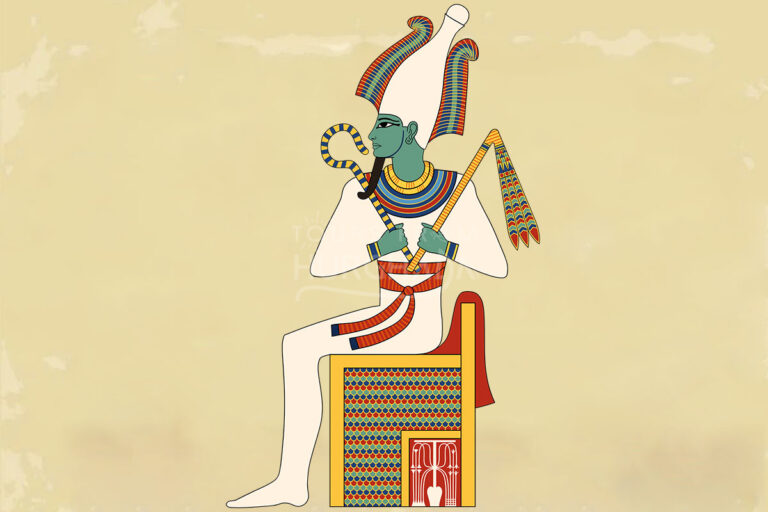
Geb and Nut’s children were Osiris, Isis, Seth, and Nephthys.
Click on their names to find out more about the Ennead gods.
List of ancient Egyptian gods and goddesses
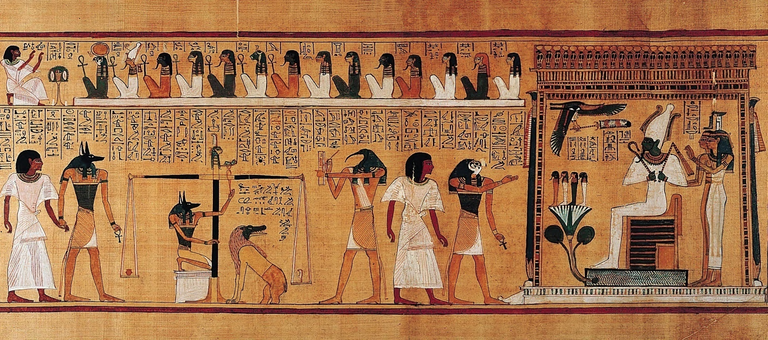
Ammit Not considered a goddess, but rather a powerful and terrifying creature who had supernatural powers. Often depicted with the head of a crocodile, the forelegs of a lion and the hind legs of a hippopotamus. Ammit’s name means ‘the devourer’, because she was believed to devour the hearts of the deceased if they were found to be unworthy during the judgment of the dead. She lived next to the scales of justice in the underworld, which was where the heart of the deceased was weighed against the feather of truth. Frequently shown in Egyptian funeral art – her image served as a warning to the deceased to live a good life and avoid wrongdoing.Amun and Amun-Ra
- Amun was originally part of the Ogdoad, a group of eight gods from another creation myth.
- He was also known as ‘the hidden one’ and was thought to be a mysterious, secret god with many aspects.
- He was often portrayed as a man with red or blue skin, wearing a headdress of two feathers, or as a ram-headed man.
- By the Middle Kingdom, Amun became linked with the king and was considered a protector of the royal family – and king of the gods.
- Amun was married to Mut, and father of Khonsu – he was also shown as the father of many pharaohs.
- In the New Kingdom, Amun was combined with the sun god Ra to form the powerful god Amun-Ra.
- Worshipped throughout Egypt – his temple at Karnak was one of the largest and most impressive in the ancient world
Anubis
- God of mummification, the afterlife and the dead.
- Often portrayed as a man with the head of a jackal or as a full jackal.
- Responsible for preparing the deceased for the afterlife and guiding them through the underworld.
- Associated with rituals of mourning and sometimes depicted as a protector of the dead.
- Worshipped throughout Egypt – his presence was felt during the entire process of preparing a body for burial and ensuring a successful afterlife.
- Despite his powerful and important role, Anubis was also seen as a gentle and caring god who took great care in ensuring that the dead were treated with respect.
Aten
- A solar god who was often portrayed as a sun disc with rays ending in hands.
- The giver of life, light, energy and food, and often shown as a bright and powerful force.
- During the reign of the pharaoh Akhenaten, the Aten became the main god of Egypt, and Akhenaten banned the worship of other gods.
- Not widely worshipped outside of the reign of Akhenaten and his cult faded away after Akhenaten’s death.
Atum
- According to one popular ancient Egyptian myth, he created the world.
- Often depicted as a man wearing the double crown of Upper and Lower Egypt.
- Sometimes associated with the evening sun – ancient Egyptians believed that he travelled across the sky during the day and passed through the underworld at night before being reborn at dawn.
- Sometimes depicted as an old man, representing the end of life – he was thought to be reborn every day with the rising sun.
- Part of the Ennead (the first nine gods and goddesses), learn about the Ennead above.
- Believed to have created Shu (the god of air) and Tefnut (the goddess of moisture) also part of the Ennead.
Bastet
- Goddess of cats, fertility (new life) and childbirth, and often associated with joy and dance.
- Frequently depicted with the head of a cat and the body of a human.
- Often worshipped by Egyptians who owned cats – cats were considered sacred animals in ancient Egypt.
- Believed to have the power to protect against evil spirits and diseases – her image was often used as a symbol of good luck and protection.
- Considered to be a gentler version of the lion-goddess Sekhmet.
Bes
- Often shown as a short, bearded man with a lion’s mane and tail, wearing a feather headdress.
- Ancient Egyptians considered those with dwarfism – including Bes – to be magical and they were sometimes appointed a high status.
- Thought to be a friendly and helpful god, who protected children, cared for women during childbirth and helped people feel safe and happy at home.
- He was also a fierce protector, carrying knives, warding off demons and killing snakes.
- Linked with music, dance and entertainment – he was often shown as playing a musical instrument or dancing.
- Worshipped throughout Egypt – his image could be found in many homes and temples.
Four sons of Horus
- Four ancient Egyptian gods who were believed to protect the organs of the deceased during mummification and the afterlife:
- Imsety, who protected the liver
- Duamutef, who protected the stomach
- Hapi, who protected the lungs
- Qebehsenuef, who protected the intestines.
- Often depicted as mummified human figures with different heads:
- Imsety had a human head
- Duamutef had a jackal head
- Hapi had a baboon head
- Qebehsenuef had a falcon head.
- Believed to have the power to help the deceased navigate the afterlife and protect them from harm.
- Often worshipped during the mummification process – their images were placed on canopic jars that held the organs of the deceased.
Geb
- God of the earth and fertility (new life).
- Often depicted as a man lying on his back, with his arms and legs stretched out to represent the land.
- Married to Nut, goddess of the sky.
- Father of many other gods and goddesses, including Osiris, Isis, Seth and Nephthys.
- The ancient Egyptians believed that he helped to bring about a good harvest.
- Also associated with the idea of stability and balance, as he was believed to help keep the earth firmly in place and prevent chaos and disorder.
- Part of the Ennead (the first nine gods and goddesses), learn about the Ennead above.
Hapy
- Thought to control the Nile river’s inundation – this is when the river floods its banks which allows crops to grow.
- Often portrayed as a man with a large belly, representing fertility (new life) and good food.
- Often shown carrying offerings of food and drink – he sometimes had lotus flowers or papyrus plants growing from his head.
- Occasionally shown as a pair of figures tying together plants which represent the two halves of Egypt – this was a symbol of unity.
- Worshipped throughout Egypt, his influence could be felt in every aspect of life that depended on the Nile river.
Hathor
- Goddess of love, joy, music and beauty – she was often linked with women, motherhood and fertility (new life).
- Often depicted in these ways:
- With the head of a cow and the body of a woman.
- As a woman with a headdress of cow horns and a sun disc.
- As a cow with a headdress of cow horns and a sun disc.
- Thought to have the power to protect against illness and danger in her role as the tame version of the goddess Sekhmet.
- Egyptian queens were often portrayed wearing the headdress of Hathor.
- Along with Isis, she was considered by the Greeks to be a version of Aphrodite (the Greek goddess of love and beauty).